Posts tagged ‘tech diving’

Trip to the Khaosok cave system

By djl_team, 9 September, 2011, 1 Comment

Back in 2009 I walked into the doors of Davy Jones Locker Diving with one thing in mind, I wanted to learn how to dive. I was met by a friendly and professional team and fell in love with diving. So instead of just doing my PADI open water course, I went all the way to Divemaster with the DJL internship program in in 3 short months I had clocked over 100 dives and was a certified dive master! After that I had to leave the island but I continued my education and became an instructor, saved some money and came back to Koh Tao!
The one thing that always attracted me to diving was the feeling of exploration, discovering ship wrecks and going where no one has gone before. So being back on the island with a wreck and Tec specialist school I decided to start my career in Technical diving, with David Polley, DJL’s resident Technical instructor and a passionate wreck hunter and cave explorer. After my final tec dive on my Tec 40 course at our local deep wreck “The Unicorn” David approached myself and my Tec Buddy Emilio with an offer too good to refuse. The offer was a trip to Khao Sok National park on the mainland to complete our cavern diver course! We both jumped at the idea and before we knew it, the gear was being packed into the back of the truck and we were off! After a night ferry from Koh Tao, and a short road trip we were there, the scenery of the park was beautiful but what we were really interested in was what lay beneath the surface of the water. First we had some theory to get out the way and playing around practising with lines and reels around the restaurant, getting some funny looks navigating our way with a t-shirt wrapped around our heads to simulate a silt out. And then it was time to get in the water. For the first dive was just practising line laying and out of air drills out side of the cavern, and simulation loss of visibility by turning our masks backwards and using touch contact to find our way to the end of the line. After we had played around with this a few times it was time to do some cavern dives. For the first couple of dives I didn’t really take in my environment as I was focussing on laying the line, checking air and working as part of a team but when it came to our last dive of the course, at Temple Cave we were ready to explore! Confident with our new learned skills we led the dive into the cavern, laying a line as we went and working as a team we navigated a safe dive in a completely alien environment, gazing upon ancient cave structures using only our torch light to see things, apart from the faint green glow off in the discance which was the entrance of the cavern. Sadly it was time to leave but not without one more dive, in a flooded part of the rainforest diving through the trees, it was an odd experience but a great one.

Then we headed further south to the town of Thung Yai, to dive in what from the surface appears to be a muddy lake, but under the surface a very different story unfolds, as it gets deeper and deeper the visibility clears up and you are inside a huge sink hole with cave system appears out of the black. The purpose of this part of the trip was for out instructor Dave, alongside with Tim and Vince to make a 100M dive in an attempt to survey the cave which is mostly unexplored, with myself and Emilio being support divers. We came back to the surface to discuss the plan and where we would meet them. Then the work began, blending gasses, filling tanks, ensuring everything was working properly. Although we had a few minor logistical problems along the way we managed to get it all together for the big dive! By the time the guys were ready to jump in we had already attracted a crowd of locals who were keen to see what we were up to and even offering to give us a hand with carrying tanks! Then soon after the 100M team had descended it was time for myself and Emilio to kit up, do our checks and head down to the rendezvous point at 21m, and as per schedule, 39 minutes into the dive, we saw 3 faint glows appear from the black hole below us as the guys were making their way back up for deco. We stayed with them for the whole deco which flew by with no problems whatsoever and before we all knew it we were all on the surface and an exchange of handshakes was made. Now it was just a matter of packing the truck, getting changed and heading north for Chumpon.

I would like to say a big thank you to my instructor Dave Polley for the cavern course and I will be doing more technical training and full cave soon. And finally congratulations to Tim Lawrence, Dave Polley and Vince for reaching the depth of 100m in a cave.
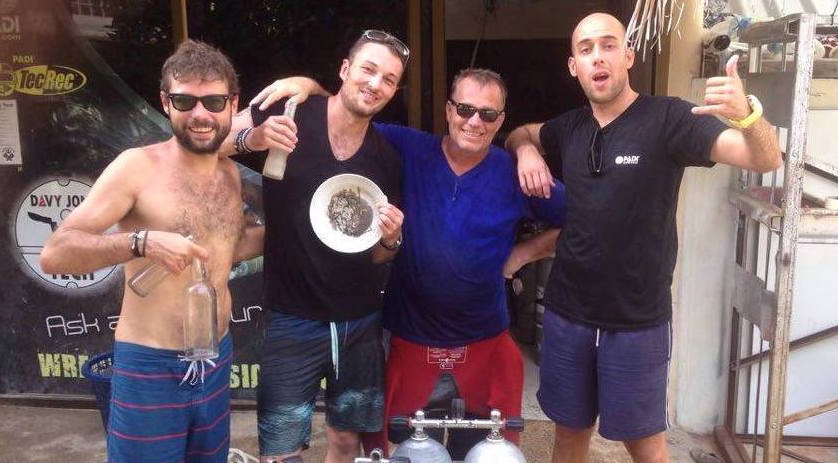
Mike Waddington… Thats me , with the beer!

Post to Twitter Post to Facebook

The Seacrest Drill Ship a.k.a “the Scan Queen”

By djl_team, 1 August, 2011, 1 Comment

Tonnage: 4400 Gross tonnage, Length: 110m Breadth: 20m Draught: 6m

Sunk by Typhoon Gay on the 3rd November 1989

91 rig workers were killed after the vessel capsized, resulting in a massive legal case brought against the ship’s owners UNOCAL. There were only 6 reported survivors, 2 Indonesian divers and 4 Thai’s, although these figures vary slightly depending on the source. Many of the bodies were never recovered.

Typhoon Gay produced winds of 100knots or more with 40ft waves. It left hundreds of sunken fishing vessels in its wake, killing 529 people and leaving 160 000 more homeless.

There are conflicting reports about the cause of the sinking of the Seacrest. The plaintiffs, relatives of the lost seamen, claimed that the drill ship had a derrick full of 200 ton of pipe that was still connected to the well head at the time that Typhoon Gay hit, making the ship unstable in high seas, with a high centre of gravity. Standard practice was to disconnect from the well head when bad weather threatened. A drill site supervisor who has withheld his name and claimed to be working for the company at the time of the sinking has stated “ The Seacrest did not have that amount of pipe in the derrick , 200 tons is a fabrication. She was not connected to the well head. The upper package was disconnected from the subsea BOP. Prior to disconnecting, pipe was run down to the 9 -5/8 shoe and hung off in the subsea BOP’s leaving a majority of the drill pipe below the sea bed. The upper package was disconnected. The slip joint was laid out. The TDS was secured above the rig floor and remaining pipe was secured in the derrick.”

Whether the pipe was disconnected or not will probably never be known as the ship could have snapped the pipe below the water line, when she capsized, making it difficult to prove or disprove the site supervisor’s claim.

No distress signals were heard from The Seacrest, and lifeboats were not found, suggesting that she capsized too quickly for the crew to respond. The ship was reported missing on Sunday the 4th of November 1989. A helicopter search located the ship floating upturned at 08h15 local time. Two rescuers were landed on the hull in an attempt to contact any survivors in air pockets in the upturned hull, but no response was received to their tapping signals.

She currently lies upside down, resting on the derrick. The starboard side is one metre from the sand, and the port side 4m. Depth is 75m to the sand, 50m to the top of the hull, where you can enter through the moon pool at 50m.

NEWSFLASH

Update:

It seems that this story is about to take another twist. The legal focus of attention was whether there was a large amount of pipe line stored in the derrick and if pipe was disconnected from the well head. After extensive research our team managed to contact the engineer working aboard the Seacrest, and he has given us the below statement:

“My name is Gunnar Gustafsson – normally called “Gus” by my English speaking friends. I am a marine engineer by profession, educated in Sweden and with an unlimited chief engineer’s license issued by the Swedish government in 1973.

I have been active in the oil field since the middle of the 70’s and I have worked for Reading & Bates (on the drillship E.W.Thornton) and for Atwood Oceanic (on the drillship Chancellorsville).

The Seacrest was a sister ship to Chancellorsville and on the latter vessel I spent over 6 years before I had to leave as the rig was taken out of service (due to the slump in the oil drilling business). I therefore feel that I know this is a type of vessel fairly well.

I was employed as chief engineer (marine department) on the Seacrest when the top drive unit was installed on the derrick. The installation work was performed when alongside in the port of Satahip (Thailand).

I cannot recall who was responsible for the installation of the top drive unit. I was not involved with the work at all, nor was the captain…though we both protested and pointed out the risks involved by placing such heavy equipment that high up on the derrick…and we were shocked when we found out that there were no plans to compensate the installation with appropriately placed ballast.

Both the captain (Alistair Cooke) and I were worried…and tried to communicate our worries to the rig management. However, we were met with disbelief, and the manager let us know that “others, who knew more than we did,” had said there were no problems at all with the installation.

Besides, we were told, the ABS (American Bureau of Shipping) had approved the installation…something we had a hard time believing – we simply had to accept it.

We were never shown any papers confirming that the installation had been approved by the ABS…meaning that we had no information about how we had to operate the vessel in order to remain within safety limits (amount of ballast in the tanks, etc.) Our requests for this basic safety information were studiously ignored.

Personally I was outraged when we left the port of Satahip without performing a simple inclination test. We had to leave without knowing anything about the altered stability of the vessel.

Already when leaving the port of Satahip we experienced problems, as the vessel leaned over heavily when we had to make a turn…and it took a very long time for the vessel to straighten up again…a clear indication that the vessels stability had been seriously compromised.

The captain, taking the vessel from port to the drill site, was the relief captain (I cannot recall his name)  and I am sure he will verify my statement about the problems he had when leaving port…I remember clearly how upset he was…upset and not a little bit frightened…as was I.

When we arrived at the drill site I was still upset and angry having “idiots” claiming that there were no risks…but my voice was ignored and, in short, I was told that I “knew nothing” and that I was “full of bullshit”…it even came to blows when I confronted one of the most ignorant and most vociferous persons on the crew – the subsea engineer.

Shortly after I had left the vessel at the drill site (normal crew change), I received a call from the rig manager telling me that I was not welcome back…and I remember that I laughed…telling him that there was no way in hell that I would return to that vessel…to do so would be to risk my life and I had no intention in doing so.

Afterwards I received a mail from Captain Cooke who let me know that also he had been told not to return to the vessel. His position had been taken up by someone hired in Thailand and my position had been taken up by a mechanic without any marine engineer’s license.

Some time after the disaster (which, incidentally, shook me to the core…a lot of good people went down with that rig, and I blamed myself for not having pushed the safety issue further) I was once more contacted by Captain Cooke who had received a request to serve as a witness in a court hearing about the incident. He let me know that they (the lawyers) had mentioned that they wanted me to do the same…something I readily agreed too…

However, I was never called and I later found out that the company managing the Seacrest had gone into receivership.

I thought that this was the end of the story…but apparently it isn’t over yet…and if I can do anything to help those who lost their loved ones then I am more than willing to do so…

Note! The information above is written down by request and on my own free will. That I felt it necessary to do so is based on the information (which I received only recently) that there has been much talk about the drill crew leaving the drill pipe in the derrick…and thus they have been blamed for causing the incident.

The drill crews onboard at the time were experienced and I have no doubt at all that they would follow the standard practises used in such situations. Thus I am sure that the incident was not caused or aggravated by any neglect on their side.

In my mind the incident was caused by the instability of the vessel…and I guess nobody is refuting that.

However, that instability was not caused by pipes remaining in the derrick; the instability was caused by the installation of the top drive…which I feel is something that should be investigated seriously.”

We are not aware of any compensation that was ever paid to the families of the seamen after the sinking. The company contracted by the American company to conduct the work, went into receivership. The parent company contracted by the Thai government to carry out the work has since been bought by a very large oil company.

Smells fishier than Chumpon…


Davy Jone’s Locker , in collaboration with the Thailand Technical Wreck Diving Project will be running expeditions to the Seacrest for the purpose of surveying it. Interested parties wishing to join in are welcome . Contact us for more information.


Post to Twitter Post to Facebook

New line on Unicorn wreck

By djl_team, 23 February, 2011, No Comment

With the increasing number of technical divers around Koh Tao the need to maintain a permanent line on the Unicorn shipwreck has arisen.  We at Davy Jones’ Locker usually like to shot and tie-in each time we visit the Unicorn as it teaches the student these valuable skills.  However the changing face of technical diving has meant that there are higher volumes of beginner tech divers with a need to hold up their profiles to 40 and 45 metres respectively.  To facilitate this, making it easier for all the instructors to run the shallower courses on the Unicorn, a permanent line was placed on it by Kris, a technical diving instructor from Davy Jones’ Locker, a few weeks ago.  The permanent line was run from 3 metres under the surface to the top of the mast and from there to the bow of the ship.  This enables the instructor to maintain a shallower profile with his students which is necessary because often when you shot the Unicorn wreck the line ends up at 48 metres and has to be lifted in to the top of the wreck so that it can be tied-in.  This has meant that the instructor has had to run a decompression profile for a deeper dive.

Unfortunately, fishermen have not always been pleased with such arrangements and they frequently cut the buoys of the mooring lines that we set up.  So when the last line was cut, a team of experienced tech divers, Tim Lawrence and Kris Harrison, returned to re-set the permanent line from 3 metres under the surface to the top of the mast and then to the bow.  This task was complicated due to poor visibility around full moon which was approximately 1 metre.  Despite this we shot the wreck, then lifted the shot-line in to the shallower part and tied in to the forward mast.  Then we located the original mooring line and ran out the bow line to the bow.   Following this, we set a permanent distance-line along the length of the wreck at 45 metres.  We returned to the mast and untied the shot-line which had already been prepped with a lift bag for recovery.  We ascended the shot, straightening out the original mooring line which was still secured to the mast.  Completing our decompression profile and gas switches we refixed a permanent buoy to this line at 3 metres.  Finally, we entered the boat, recovered our shot and returned to Koh Tao.  Completing this task should make it easier for shallower tech courses to be run in the future – until the next fisherman cuts it.  While completing this exercise, we also cut some of the ancillary lines which strewn the unicorn wreck, waiting to entangle unwary divers.  This task is constantly required on the Unicorn because local fishermen are constantly snagging it with lines.  The job is made easier when all the schools join in, helping to make the wreck safer to dive.  Davy Jones’ Locker Technical Dive Team.

Kris Harrison

Shot-line tied in to the mast with the original mooring line run through it

Tim Lawrence

Post to Twitter Post to Facebook

Overhead environment training

By djl_team, 11 October, 2010, No Comment

Tomorrow the DJL tech team and their students will be diving the recently descended, “Trident” wreck.. the “MV Trident” was a technical live aboard that the owners purposely sunk in 36msw as training wreck… The depth allows for long bottom times with minimal decompression, perfect for technical overhead environment training dives… We are currently in the middle of a technical, trimix, and Level 4 cave course, that will culminate in a week of diving the deep caves of southern Thailand…

Post to Twitter Post to Facebook

Tech diving wreck trip to the Pangan

By djl_team, 22 September, 2010, 4 Comments
Tech gear from the Pangan trip

Tech Equipment

Rebreather equipment check

Kris checking over his Rebreather equipment

Technical Diving Koh Tao Thailand

Tech Diving

Tying into the Pangan wreck

Tie Off

16.9.2010 a team of technical divers from Davy Jones Locker set out to dive the wreck of the Pangan, a Thai military transport lost in bad weather.

In the 70’s the pangan was ordered to dump expired ordinance and in the official report of the sinking the captain claimed the cargo shifted and she started to take on board water. The captain then gave the order to abandon ship.

I was lucky enough to lead the first buddy team to dive her and we were surprised to find evidence of fire damage on the stern of the vessel, as the metal in this area was blown and easy to cut through, suggesting rapid cooling of the metal when she sank.

During this trip we were disappointed to find the top of the bridge to have been ripped off the main super structure. Even so she is still an impressive site and swimming around the gang ways 40 years under the sea has done little to diminish the care taken by the shipwrights when she was originally constructed.

Tech Diving

Running the line

Tech Diving

Looking out of the bridge of the Pangan

Tech Diving

Kris Diving the Pangan

Post to Twitter Post to Facebook